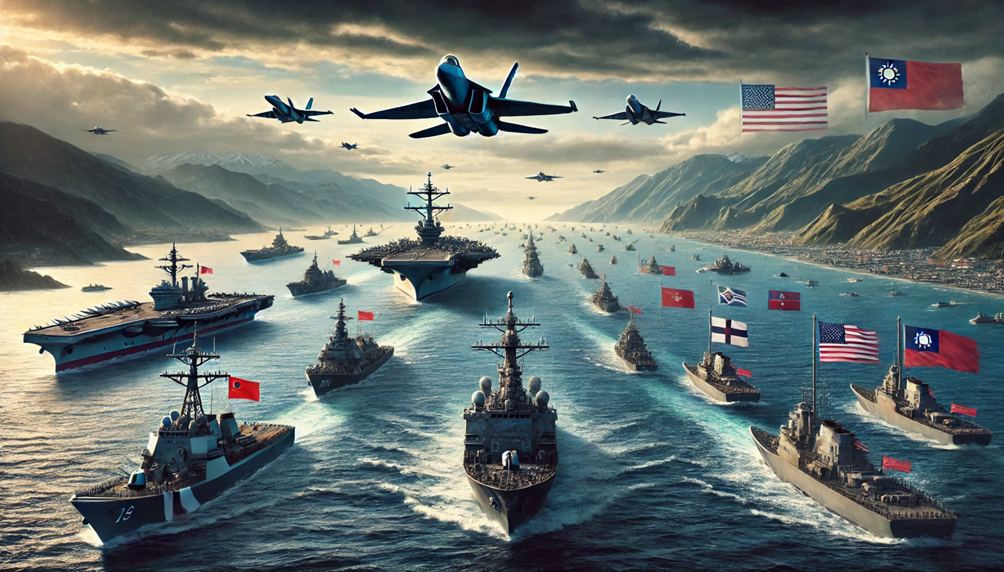


The Taiwan Strait has become one of the most dangerous geopolitical flashpoints in the world today, with increased military activity and diplomatic saber-rattling threatening to ignite a conflict that could draw in the United States, China, and other major powers. Recent developments signal an alarming escalation in tensions, and the consequences of any miscalculation could reverberate far beyond the Asia-Pacific region. As China ramps up its military exercises near Taiwan and the United States reaffirms its commitment to defend the self-governed island, the situation is becoming increasingly volatile, raising questions about how long the status quo can be maintained.
China’s Increasing Aggression
China’s intentions toward Taiwan have never been subtle. The Chinese Communist Party (CCP) views Taiwan as a breakaway province, an inseparable part of its territory that must eventually be reunited with the mainland—by force if necessary. In recent years, Beijing has ramped up its military presence in the Taiwan Strait, conducting frequent naval exercises, flying warplanes into Taiwan’s air defense identification zone (ADIZ), and modernizing its armed forces at an unprecedented pace. These aggressive actions have heightened fears of a Chinese invasion or blockade of Taiwan.
Chinese President Xi Jinping has made no secret of his desire to accomplish what he sees as the “great rejuvenation of the Chinese nation,” with the reunification of Taiwan being a vital component of that vision. This rhetoric, coupled with China’s growing military capabilities, has created an environment of perpetual tension, where one wrong move could trigger an all-out conflict.
Taiwan’s Response: Strengthening Defenses
In response to China’s provocations, Taiwan has steadily increased its defense spending, modernizing its military and purchasing advanced weapons systems from the United States. Under President Tsai Ing-wen, Taiwan’s government has been vocal about its resolve to defend its sovereignty and maintain its democratic way of life. In recent years, Taipei has strengthened diplomatic ties with like-minded democracies, gaining more visibility on the world stage despite China’s ongoing efforts to isolate the island diplomatically.
However, Taiwan’s defense remains heavily reliant on the U.S. military. The United States has long maintained a policy of “strategic ambiguity,” signaling that it would defend Taiwan in the event of a Chinese invasion without explicitly committing to military action. This approach has helped maintain peace in the region for decades, but as tensions escalate, the risks of strategic ambiguity may be reaching a breaking point.
The U.S. Role: Walking a Tightrope
For the United States, the situation in the Taiwan Strait is a delicate balancing act. On the one hand, Washington has repeatedly emphasized its commitment to Taiwan’s defense under the Taiwan Relations Act, which obliges the U.S. to provide Taiwan with the means to defend itself. On the other hand, the U.S. must avoid provoking China into a military confrontation that could spiral into a broader conflict involving other regional powers, including Japan and South Korea.
The Biden administration has taken a more assertive stance on Taiwan than its predecessors, reaffirming that the U.S. will come to Taiwan’s aid in an attack while simultaneously strengthening alliances in the Indo-Pacific. The recent AUKUS pact between the U.S., U.K., and Australia and increased military cooperation with Japan and South Korea signal China that the West is prepared to counterbalance its growing regional influence.
However, this more assertive posture has not come without consequences. China views these moves as part of a broader U.S. strategy to contain its rise, which has only intensified its military posturing. The frequent U.S. naval patrols through the Taiwan Strait, while demonstrating freedom of navigation, are seen by Beijing as provocations and have contributed to the deteriorating situation.
The Risks of Escalation
The greatest danger posed by the escalating tensions in the Taiwan Strait is the risk of miscalculation. China and the United States are locked in a high-stakes geopolitical game where each side tests the other’s resolve. However, with both sides unwilling to back down, the risk of accidental conflict is growing.
While not imminent, a Chinese invasion of Taiwan is becoming more plausible as Xi Jinping consolidates power and grows more determined to achieve what he views as a historic mandate. Such a move would likely provoke a U.S. military response, leading to a conflict that could quickly escalate into a regional or even global war, with disastrous consequences for the worldwide economy, international stability, and the millions of lives at stake.
Furthermore, other countries in the region, including Japan, South Korea, and Australia, would likely be drawn into the conflict through direct military involvement or as part of the economic fallout. The Taiwan Strait is one of the world’s busiest shipping lanes, and any disruption would have severe implications for global trade, particularly in the semiconductor industry, where Taiwan plays a dominant role.
A Path Forward?
Given the stakes, all parties must prioritize diplomacy and dialogue over military confrontation. The international community, especially the U.S. and its allies, must work to de-escalate tensions in the Taiwan Strait while making it clear that any aggression by China will come with significant consequences.
China, for its part, must recognize that any attempt to reunify Taiwan forcibly would not only be met with military resistance but would also irreparably damage its global standing. For all of its military might, China relies heavily on international trade and economic cooperation, and a war over Taiwan would shatter the delicate balance it has worked to maintain.
At the same time, Taiwan should continue strengthening its defenses while seeking diplomatic solutions to the crisis. Although Taiwan’s sovereignty is non-negotiable, finding ways to lower tensions with Beijing could buy valuable time and prevent a catastrophic conflict.
Conclusion: A Global Responsibility
The escalating tensions in the Taiwan Strait are not just a regional issue but a global one. How the international community responds to China’s aggression will shape the future of worldwide security and determine whether the principles of democracy and self-determination can withstand the pressures of authoritarianism. The U.S. and its allies must remain steadfast in their support for Taiwan, but they must also seek to de-escalate tensions and avoid a catastrophic conflict that could engulf the world.
As the world watches the Taiwan Strait, it is clear that this small island has become a symbol of the larger struggle between democracy and authoritarianism. The stakes could not be higher, and the path forward is difficult. But with the right mix of diplomacy, deterrence, and global solidarity, there is still hope for a peaceful resolution to this dangerous situation.