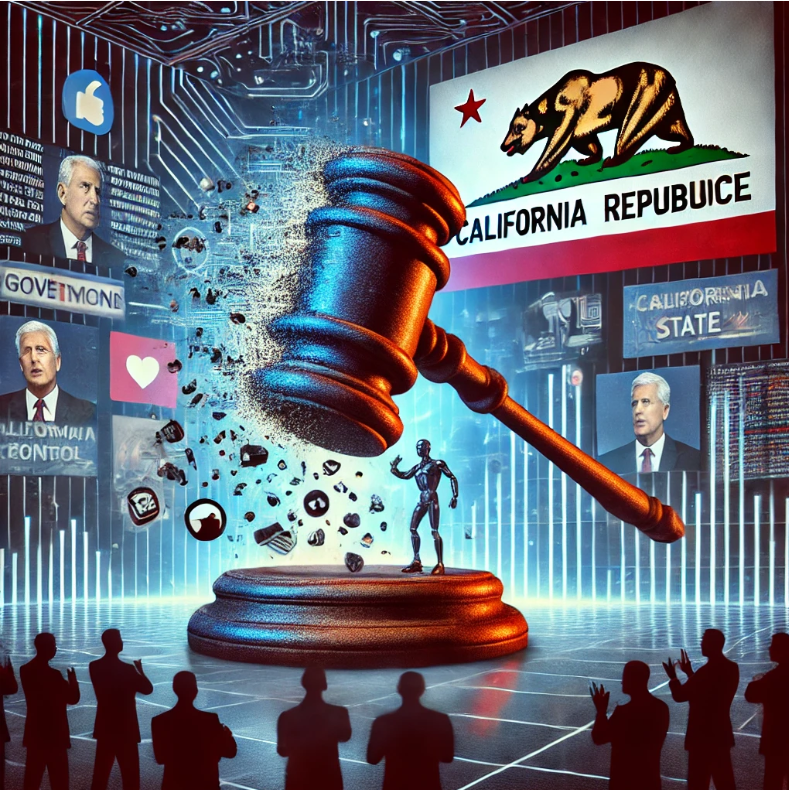


A Thinly Veiled Attempt at Control
Governor Newsom argues that this new law is necessary to maintain elections’ integrity and ensure fabricated media do not mislead voters. On the surface, this seems reasonable; no one wants fake videos of candidates saying things they never said to sway public opinion. However, the deeper issue is who decides what constitutes a deepfake and how this power could be weaponized against political opponents or those critical of the ruling party.
In an era where trust in the media is already at an all-time low, this law hands over tremendous power to government agencies to determine what information the public can and cannot see. It raises serious questions about censorship and how such laws can be abused to silence voices that challenge the narrative pushed by those in control.
Free Speech in Peril
One of the core principles of a democratic society is the free exchange of ideas—even controversial ones. By allowing the government to police content based on the mere potential for harm, we open the door to suppressing legitimate discourse. Today, it’s deepfakes; tomorrow, it could be any content deemed misleading, inflammatory, or inconvenient for those in power.
Critics of this law argue that it could suppress memes, parody, satire, and other forms of expression that have historically played a crucial role in political discourse. Satirical content that pokes fun at politicians, including Governor Newsom, could easily be targeted under the guise of fighting misinformation. Imagine if past political cartoons or satirical skits like those on “Saturday Night Live” had been subjected to this level of scrutiny—our political landscape would look very different.
A One-Sided Shield?
It’s hard not to notice the timing of this law, which comes as California gears up for another contentious election cycle. Newsom’s history of aligning with left-leaning policies raises concerns that this law could disproportionately impact conservative voices or any opposition critical of the current administration. Could this be an attempt to shield candidates like Kamala Harris, who faces mounting scrutiny, from damaging AI-generated content? The potential for bias in enforcement is glaring, especially when the arbiters of “truth” stand to benefit politically.
Historically, laws that begin as protective measures often evolve into tools of control. While the intent may be to protect, the execution can quickly become selective, favoring one side while cracking down on the other. The mainstream media, already biased, might support such laws, amplifying their impact and creating an echo chamber that drowns out dissenting voices.
The Tech Dilemma: Can We Trust the Enforcers?
Newsom’s law doesn’t just impact voters; it puts tech companies in a precarious position as the enforcers of this new policy. Platforms like Facebook, Twitter, and YouTube would now have to increase their surveillance, identify AI-generated content, and remove it. But these tech giants are already notorious for their inconsistent content moderation practices, often accused of favoring liberal viewpoints. This law adds another layer of complexity to an already flawed system and raises concerns about tech companies’ role as gatekeepers of information.
The real question is whether we trust these platforms—or the government—to discern what’s real and what’s not. The rapid advancement of AI technology means that even legitimate content could be flagged, restricted, or removed under the broad terms of this law. Who holds the power to challenge such decisions, and what recourse do individuals have if their content is unfairly censored?
The Bigger Picture: A Slippery Slope
Gavin Newsom’s decision to sign this law reflects a growing trend among political leaders to control narratives under the guise of “protecting” the public. While deepfakes and AI-generated content certainly pose challenges, the answer isn’t more government control—it’s more transparency, media literacy, and public awareness. Education, not censorship, is the key to equipping voters to discern truth from fiction.
The implications of this law stretch far beyond California. As other states look to follow suit, we must ask ourselves: At what cost do we safeguard our elections? Is the trade-off worth sacrificing the bedrock of free expression that defines America? When we allow the government to play gatekeeper, we risk losing far more than we protect. Newsom’s law is a wake-up call, a reminder that the greatest threat to our democracy isn’t misinformation—it’s the unchecked power of those who claim to guard the truth.
Conclusion: Voters Must Remain Vigilant
As we approach another election, voters must stay vigilant. Newsom’s deepfake ban isn’t just a California issue; it’s a glimpse into a future where those in power dictate what’s acceptable discourse. The next time you hear about a law designed to “protect” you from misinformation, take a closer look at who benefits—and who loses. Democracy thrives on the free flow of information, and once we start blocking that flow, we’re no longer protecting democracy; we’re dismantling it from within.