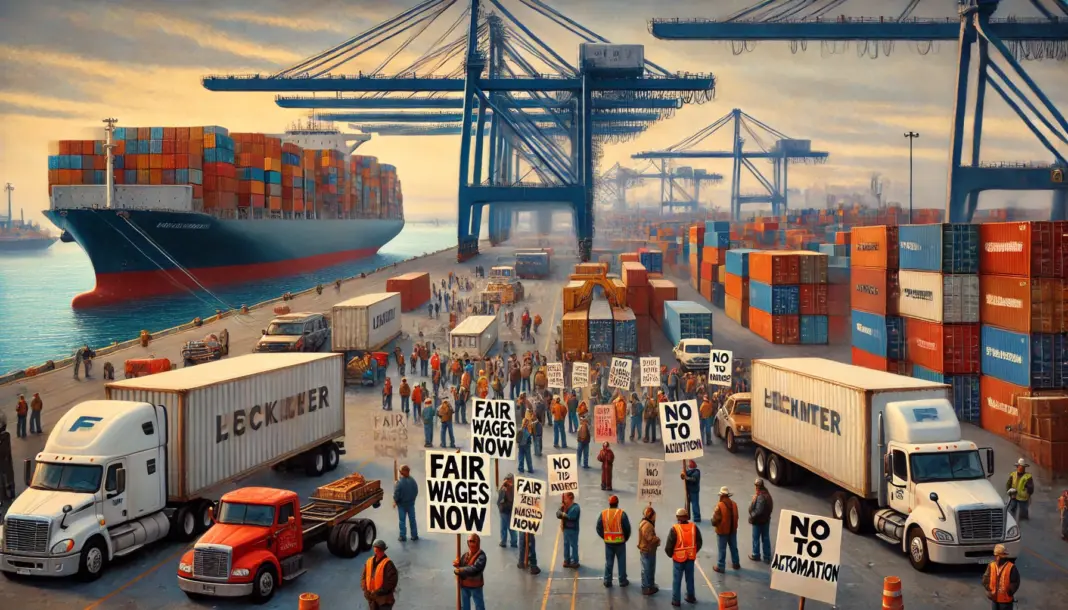


The strike sweeping East and Gulf Coast ports has quickly escalated into a critical standoff with significant economic and social ramifications. With key demands focused on wage increases and resistance to automation, the strike spotlights the broader struggles of labor in an evolving industry.
Billions in Trade Disrupted as Strike Unfolds
Since the strike began in early October, more than $2 billion worth of goods, including cars, consumer electronics, and food, have been held in limbo at significant ports like New York, Baltimore, and Houston(WCBU)(opb). Dockworkers, represented by the International Longshoremen’s Association (ILA), halted operations after negotiations with the U.S. Maritime Alliance (USMX) failed to produce a new contract. The disruption is already pressuring industries reliant on maritime trade, with firms scrambling to reroute shipments to West Coast ports to avoid costly delays.
Dockworkers Demand Higher Wages
The demand for wage increases is at the heart of the strike, which dockworkers argue has not kept pace with the industry’s recent profits. The shipping industry experienced a massive financial windfall during the COVID-19 pandemic, while dockworkers continued working under hazardous conditions. Yet, the ILA has criticized recent wage offers as inadequate, with the latest proposal offering a 50% pay increase over six years(WCBU)(opb). Union leaders argue that this still doesn’t fairly compensate workers for their role in maintaining the flow of essential goods during the pandemic and beyond.
Automation: The Threat to Job Security
Another central issue fueling the strike is automation. The dockworkers are fighting against the increased use of semi-automated equipment, fearing it could eventually replace a significant portion of their workforce. Although the shipping industry has argued that automation can improve efficiency and maintain competitiveness, workers see it as a direct threat to job security. The union has called for guarantees that automation will not expand without further negotiation, an unmet demand(opb).
Ripple Effects Across the Economy
With the strike extending into its first week, companies reliant on imports and exports have already felt the pinch. The alcohol industry, in particular, faces a critical shortage of spirits, as over three-quarters of all imported liquor passes through the affected ports. Trade groups have warned that if the strike persists, prices for various consumer goods could increase as the holiday season approaches(WCBU)(opb). The uncertainty surrounding how long the strike will last forces companies to adopt contingency plans, including rerouting shipments to unaffected West Coast ports, though this solution only offers limited relief.
A Pivotal Moment for Labor Rights
This strike marks a defining moment for labor rights in the maritime industry, where workers are standing up not just for better pay but for their future in an automated world. The dispute illustrates the broader tension between labor and management across various industries where technological advancements are displacing traditional jobs. As negotiations remain stalled, the strike has the potential to set a significant precedent for how industries and unions handle these challenges moving forward.