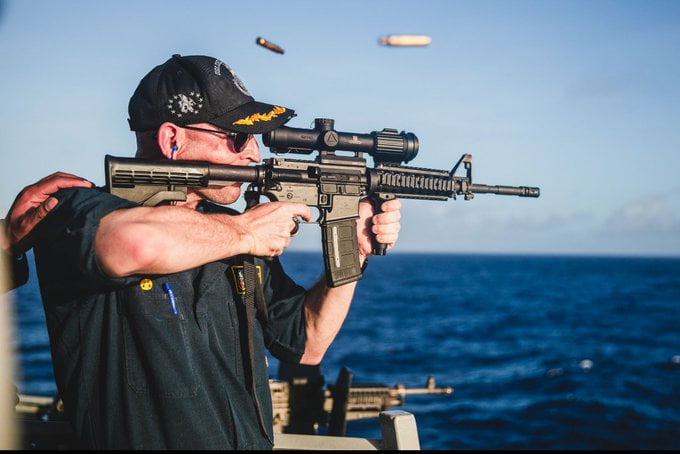


The recent removal of Cmdr. Cameron Yaste, from his position as the commander of the USS John McCain, has sparked significant attention, not just for the circumstances surrounding his dismissal but also for what it reveals about leadership, accountability, and optics in today’s military. While the Navy’s official statement attributed Yaste’s dismissal to a “loss of confidence” in his ability to command, the timing of this decision—just months after a widely ridiculed social media post—raises questions about public perception’s role in military leadership.
The incident that likely tarnished Yaste’s reputation occurred in April when a photo of him aiming a rifle with a backward scope was posted on the Navy’s Instagram account. While some may consider this a minor error, the reality is that it became a major embarrassment for the Navy. Social media users were quick to point out the mistake, with the Marines even sharing a properly configured rifle in what felt like a subtle dig at the Navy’s misstep. The incident may seem trivial, but in a profession that prides itself on precision, professionalism, and readiness, even small mistakes can have a more considerable symbolic impact.
Leadership in the military is about much more than just operational command. It’s about setting an example, embodying discipline, and maintaining the highest standards of readiness and professionalism. The image of a Navy commander, especially one tasked with leading a guided-missile destroyer, mishandling an essential piece of equipment sends a message far beyond the individual involved. It creates doubt in the eyes of subordinates and the public regarding the competence of those at the helm of our national defense.
In today’s age, where public perception is magnified through social media, every action—no matter how small—is under a microscope. The military cannot afford to appear incompetent, even in the smallest of ways, especially when global tensions are high, and the USS John McCain is positioned in the Gulf of Oman to deter aggression from adversaries like Iran. In such a critical region, leadership must inspire confidence, not only in military operations but also in public relations. Unfortunately, this photo represented a failure in both areas.
Some may argue that Yaste’s career accomplishments, including prestigious awards like the Defense Meritorious Service Medal and the Navy and Marine Corps Commendation Medal, should overshadow this incident. However, a commander’s ability to lead is judged by past achievements and current actions. The rifle scope blunder might have been the tipping point that led to a broader evaluation of Yaste’s leadership, ultimately resulting in the Navy’s decision to replace him with Capt. Allison Christy.
Yaste’s removal also reminds military leaders to maintain vigilance in all aspects of their duties. The Navy’s decision was not merely about punishing a single mistake but about ensuring the integrity and competence of its leadership. The USS John McCain and the other regional assets are tasked with protecting American interests during escalating tensions in the Middle East. The stakes are far too high for anything less than exceptional leadership.
In conclusion, this incident is a cautionary tale for military leaders and organizations. While a single mistake might seem insignificant, the ripple effects can be profound, significantly, when amplified by social media. Commanders like Yaste are entrusted with immense responsibility and any loss of confidence—whether due to operational decisions or public embarrassment—must be taken seriously. The Navy made the right decision to prioritize leadership competence, ensuring that those in command are fit to lead in every sense.